

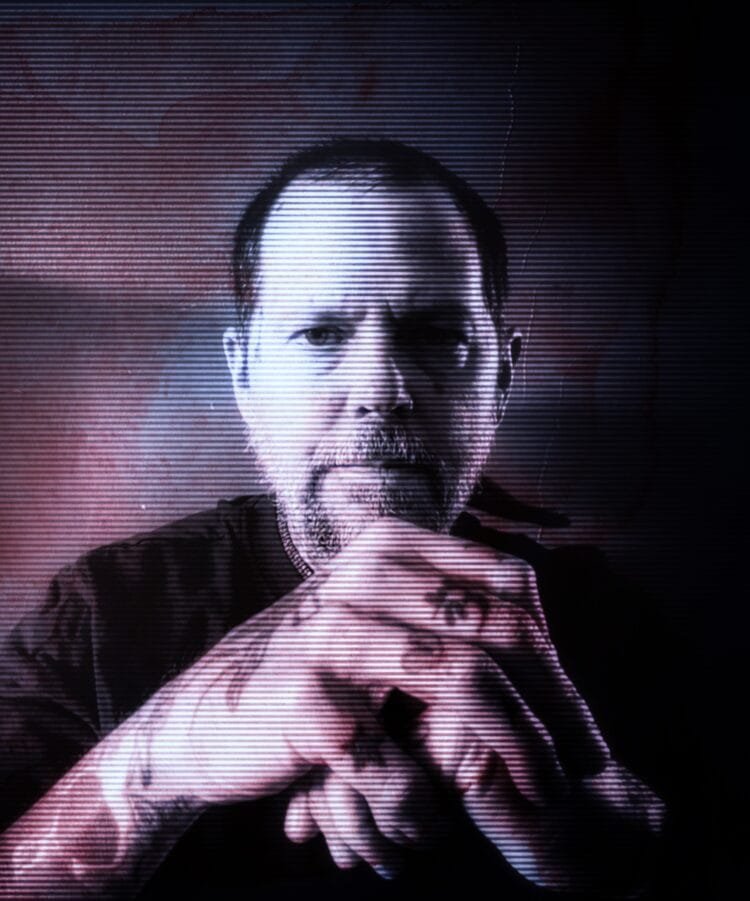
Aaron D.C. Edge is an American multi-instrumentalist, producer, engineer, graphic designer, and photographer based in London. Originally from the East Coast, he became known in the late 1990s and early 2000s as a guitarist in the Seattle metalcore band Himsa and through projects such as Harkonen, later serving as art director for Southern Lord Recordings.
He is widely recognized for the 2013 collaborative album Lumbar with YOB’s Mike Scheidt and Tad Doyle, recorded while he was confronting a new diagnosis of multiple sclerosis. Despite ongoing health challenges, Edge has remained highly prolific, releasing music across sludge, black metal, hardcore, and dark country under numerous monikers including Bible Black Tyrant and Man of Multnomah. His dual work as musician and visual artist has left a lasting imprint on the underground heavy music scene.
You came up in the East Coast hardcore/punk scene D.C./Philly/Richmond areas (in bands Grip, Anonymous, Structure 24, Autumn, Christ and Genuine) before moving west in the late ’90s (then in Black Bible Tyrant, Brothers of the Sonic Cloth, Harkonen, Hellvetika, Himsa, Iamthethorn, Lumbar, Process Black, Ramprasad, The Forest of Knives, The Horde, Time And The Moth).
How did that early environment shape your approach to music, and what prompted the shift toward the heavier, more atmospheric sounds you’ve explored since?
Aaron: It brought me from playing floors with a bad PA system to enjoying mixed monitors on stages, from making cassette demos in a garage to recording with incredibly skilled engineers in beautiful studios, from touring in broken down cars and vans to the luxury that is a tour bus.
Though, that’s not to say that all the tough, early days weren’t incredibly important in shaping my character (and multiple layers of patience for all things in/out of my control). Every step—forward and back, every choice—good and bad, churned me into the man I am today.
You served as art director for Southern Lord Recordings and designed a huge amount of the label’s visual identity. What was it like collaborating with Greg Anderson, and how did that role influence (or contrast with) your work as a musician and producer?
Aaron: Working for Greg, and the rest of the small Southern Lord staff, was the greatest job I’ve had. Though I’ve designed for several record labels over the years, art directing a single one was pure joy.
Even the stressful days and situations were pure gold. I only stopped working for Greg and Phil because my health became so poor, I was forced to move back to the Northwest from Los Angeles. Mr. Anderson needs daily meetings with his staff, and he wasn’t interested in me working in a remote status from London. Understandable. If that ever changes, I’d jump right back into that job, no question.
The bands, the printers, the venues, our reps at other labels and record stores were brilliant and of the highest caliber. I made incredible connections in those two years (to the day) of art directing Southern Lord. Every job after has been “meh”.
Lumbar’s The First and Last Days of Unwelcome (with Mike Scheidt and Tad Doyle) was created during a particularly difficult period after your MS diagnosis. Can you walk us through the process of writing and recording that record—especially handling all the instruments yourself under those conditions—and what it meant to turn that experience into music?
Aaron: It can be summed up as a necessity. It had to be created and shared with the world… I am forever thankful for Mike, Tad, Brad, Daniel and Greg for the vocals, engineering, mixing, mastering, artwork and support in the process. The writing and recording was cathartic and primal, pure and simple. I was destroyed in the process and rose from those ashes after. I an so very thankful for the time, talent and energy all of those fellas donated to the Lumbar cause.
That process also helped steer me into my solo work, of which, until then, I’d only done a few records on my own.
And now, as The Lumbar Endeavor, my wondrous comrade CVSPE and I create and share many thick riffs, themes, ideas and dark art with folks around the globe.
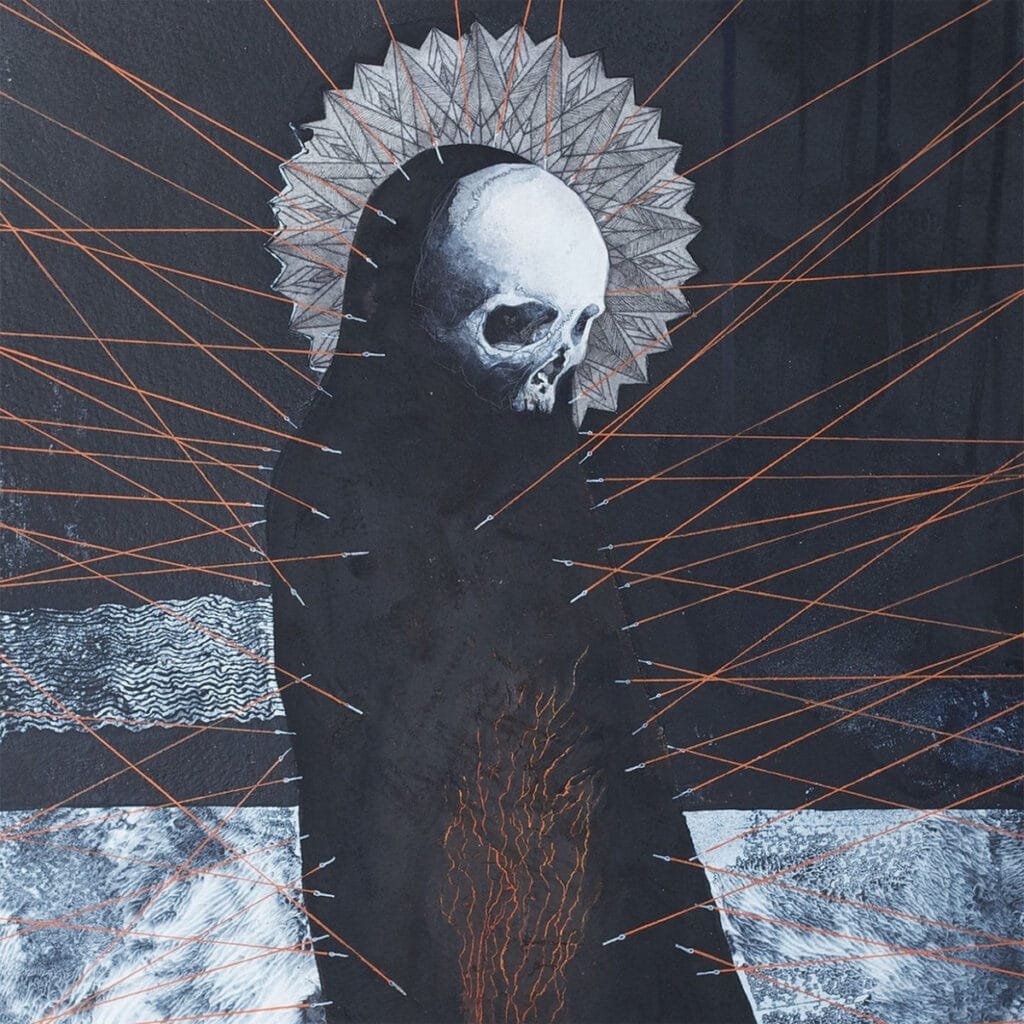
Living with multiple sclerosis has clearly affected how you play and create (from hand pain limiting traditional drumming/guitar work to using programmed elements and simpler setups). How has the condition changed your creative process over the years, and what keeps you so prolific across so many projects?
Aaron: You know, I think about this all the time. I’ve had heavy discussions with close musician pals, fellow artists, my wife and talented stepdaughter too… we creative humans have a need to make stuff. There’s no way around it.
And, as my diagnosis has changed over the years, I’ve learned how to move forward with the tools I’ve got around me. Do I wish I could still physically play drums? You bet. It’s a bummer to program drums, but it’s all I got. Would I love to record amps on 11 in nice studios all the time? Who wouldn’t, but I’ve not the budget.
My home studio, though admittedly laughable to most, gets the job done for me… just like that ol’ cassette player we used to use in my bedroom to document all our chugs and blast beats of our early band practice fumblings in the 80’s. Even my bicycles have electronic shifting, as buttons are easier than levers for my pained hands.
Though I know there’s no cure for Multiple Sclerosis—and, I certainly have real bad days—I think of it as nature: we aren’t here to control it, it controls us. Once you let go a little, the rough stuff is a bit easier to swallow.
Your output spans hardcore, sludge/doom, black metal-leaning work (Bible Black Tyrant, Hellvetika, Interitio, etc.), instrumental projects, and even darker country under Man of Multnomah. What draws you to such a wide range of styles, and how do you decide which ideas become which project?
Aaron: Great question. I suppose, like coffee, there’s no one flavor, notes or origin of it that is best. Every cup, like every genre of music, interests me. Even that awful gas station brew that has sat on a burner all day can still get you to the next town. Ya know?
We humans are so very lucky to have ears, music is incredible! It inspires, changes moods… and with so many different temperatures, volumes, speeds, vibe, clarity or lack there of.
Beyond music you’ve been involved in photography (including bicycle-related work), cycling, and earlier in life spent time in Hare Krishna temples with an interest in Eastern philosophy. How do these other parts of your life feed into or balance your music-making, especially given the physical challenges you’ve faced?
Aaron: Man Ken, you’ve done your research, very kind of you to do so and have an interest in me and my craft.
In our London flat, my family jokes about my life as a parallel to that of Forest Gump. I mean, not in the ‘change the world’ kinda’ way, obviously. But, I’ve certainly tasted many things, tried and failed at so many too. I’ve bitten off more than I should have and barfed back up things I should have avoided. Crumbs from under a bridge have sustained me back to my folks house after running away. I learned to center myself a bit while worshipping imaginary blue Gods. I capture images with cameras, so not to forget memories as I make them. I’ve been known to sketch some, read from time to time, laugh, swear, promise, break promises and jump off cliffs when my family watched in horror.
But, without taking chances, taking advice, taking that coin off the ground, taking a hug when they are given out… well, we might miss out on life.
My father died this summer and it’s really reminded me to live life as much as one can. It’s all waaaaaay too short.
A big thank you to Aaron for all that he creates and taking the time to talk to Inhale the Heavy!
Aaron D.C. Edge: Website | Interitio | The Forest of Knives | Time and the Moth


Thank you Ken!!!
Of course, it’s my pleasure!!! \m/
All waaay too short, live it while you have the ability. Wise words from an incredible human.
Agreed!!! \m/